
Hiring for Potential. What Do You Do When the Candidate Has No CV?
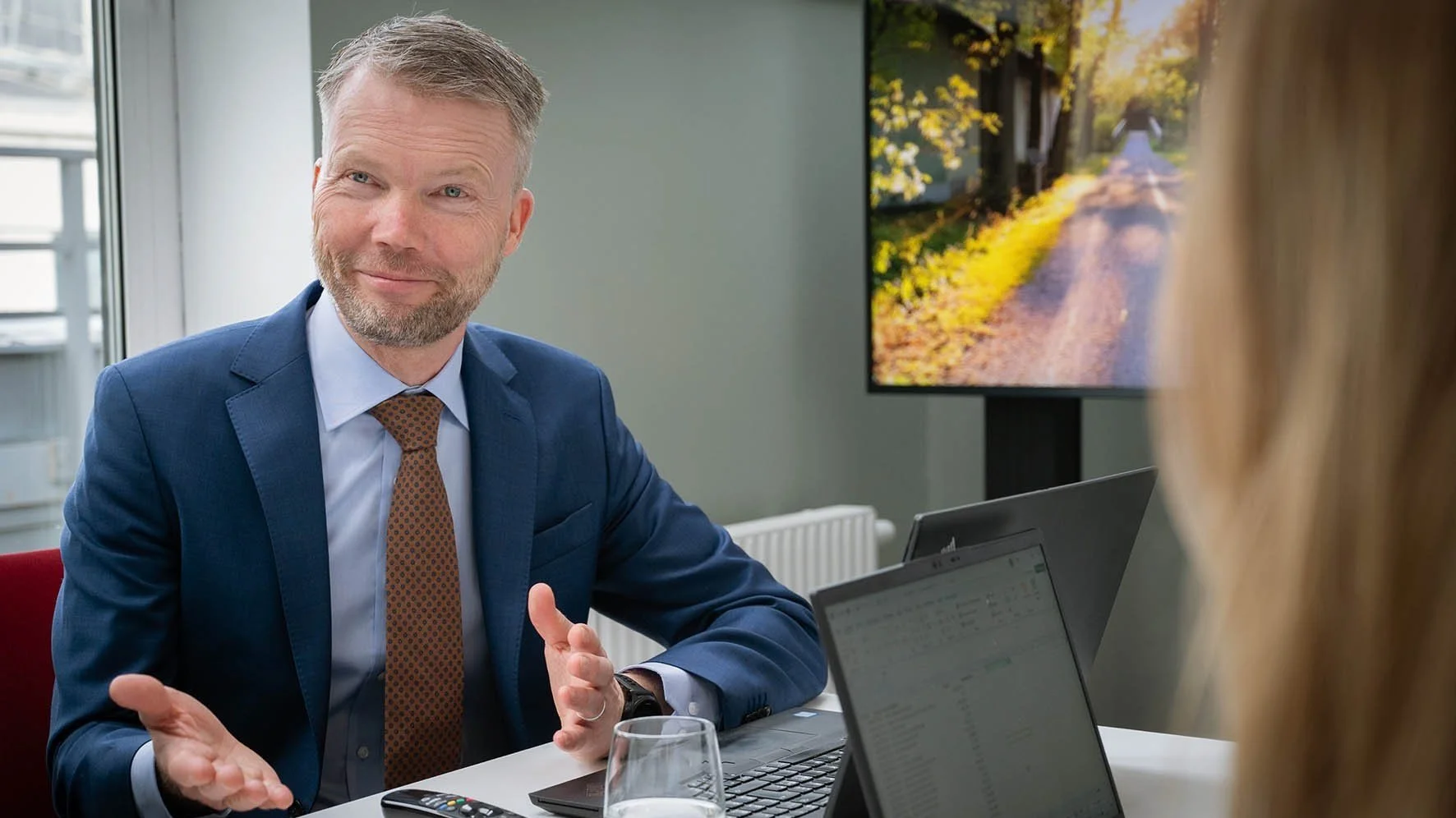
Mattias Elfgren, CEO and accounting expert at Tiego, in a column for Ekonomisverige.
How do you actually interview for potential?
When a student has not yet had time to build up experience in a CV, the conversation needs to focus on something else, namely how the person thinks, learns and collaborates. At Tiego, we have spent the past few years trying to develop an approach for exactly this.
We often say that we want to hire young and talented students from universities and colleges. At the same time, the interview process naturally looks different when the candidate is still at the very beginning of their career.
There are no past assignments to analyse, no major projects to reflect on and few situations where experience has had time to build over the years. Yet both employer and student need to understand whether this could be the right place to start a professional journey.
For us at Tiego, it has therefore become important to let the conversation focus on something other than what is typically found in a CV, less on what a candidate has already done and more on how they think, learn and work with others.
Life decisions reveal more than you might think
In our first meeting, we have started with a mutual discussion about key decision points in life. This might include choices such as which high school to attend, whether to pursue a sport seriously or to step away from one. We often explore attitudes toward training and team sports in a bit more depth.
The point is not that everyone needs a background in sports. Rather, these kinds of choices often say something about discipline, motivation, and the ability to stay focused over time, as well as teamwork
At the same time, it is important that the conversation is genuinely two-way. Everyone involved in the interview also shares their own choices, doubts and detours. The student should not only be evaluated, but also gain a sense of who we are at Tiego, how we think, what drives us and what expectations actually look like in practice.
An exam can say more than a CV
In the next step, we introduce something that may sound a bit unusual. The candidate brings along an accounting exam, not to be tested, but to review it together with us.
The focus is on explaining the problem, how the knowledge was built and how the reasoning led to the final answer. For us, this creates a deeper dialogue around problem solving and understanding. For the student, it becomes a conversation on familiar ground.
At the same time, we gain valuable insight into what is actually being taught at universities today.
When an external perspective asks the questions
We also complement our own interviews with a step where an external recruitment specialist conducts assessments and provides feedback. The idea is not to let a test decide who gets the job, but to gain an additional professional perspective on how a person makes decisions, solves problems and collaborates with others.
In our most recent recruitment, this step was highly appreciated by the candidate. The assessments became a basis for discussion, where we could talk together about working styles, pace, attention to detail and how one responds in different situations.
For many young finance professionals, this is the first time someone asks more structured questions about how they actually work, how they react under pressure, when things are unclear or when they need to collaborate with people who work differently from themselves.
For us as an employer, this provides a more objective perspective than we can get from our own conversations alone. For the candidate, it is an opportunity to reflect on strengths and areas for development in a way that can remain valuable long after the recruitment process is over.
We of course hope that the people we hire will stay with us for a long time. Even if our paths were to diverge in the future, it feels meaningful to know that they early in their careers received thoughtful and professional feedback on how they function in a professional setting.
Learning begins in real projects
Once we bring a student on board, we also find that onboarding looks different. Letting someone grow into the role part time is often much smoother than hiring a recent graduate full time and then trying to find the right tasks afterward.
The development becomes more natural, both for the individual and for the organisation.
An important part of this is how we work with workshops for prospective clients. We sign NDAs, gain access to detailed data and process it over roughly ten days into a reasonably complete group consolidation. It is an intense process where junior and senior colleagues work closely together.
The client is involved, insights are created in real time and the understanding of both the problem and the solution deepens. The system decision comes only after the workshop.
In these projects, an energy emerges that is hard to replicate in more theoretical settings. For students and recent graduates, it becomes real learning. For us, it is a way to build capability and see people grow. For the client, it is also an opportunity to get to know both the solution and the team, experienced professionals as well as younger colleagues.
I still remember what it was like starting out as a young finance professional during my time as an auditor at EY, the desire to do things right, the uncertainty before the first assignments and the feeling that learning only truly accelerated once you were part of real work.
When I meet our own junior colleagues today, I hope they are brave, brave enough to sometimes be pushed slightly out of their comfort zone, but always surrounded by experience. That is usually where development takes off.
Today, there is also something we did not have back then. With AI, vast amounts of information, examples and analysis are constantly available. Used in the right way, it can support reflection and understanding and act as a powerful lever for building competence faster. It is not a substitute for judgement, but a tool for learning.
For me, this leads to a simple message to our industry. We need to get better at recognising the value of students and recent graduates, not only as a future promise, but as an opportunity here and now.
Looking back at one’s own student years, it becomes clear how valuable it would have been to work closely with experienced colleagues in real situations early on.
Perhaps that is where we need to begin if we are serious about talent development and the future of the profession, to dare to hire potential long before it has had time to become a CV.
